Introduction
Social, economic, and environmental conditions influence patients’ ability to access care, manage chronic disease, and adhere to treatment recommendations. National initiatives such as Healthy People 2030 define social determinants of health as the conditions in the environments where people are born, live, learn, work, play, worship, and age that affect health, functioning, and quality-of-life outcomes.1 In clinical settings, these broader social determinants often manifest as individual health-related social needs, including food insecurity, transportation barriers, housing instability, utility needs, financial strain, interpersonal safety concerns, and limited social support.2
In Mississippi, social needs are especially important because they intersect with longstanding health disparities, rural access challenges, chronic disease burden, and primary care workforce limitations. The Mississippi State Department of Health has noted that the state ranks last or near last in many leading health outcomes and that disparities are worse among populations facing social, economic, and environmental disadvantages.3 The Mississippi Primary Care Needs Assessment further documents the relationship among health status, access barriers, provider shortages, and adverse social determinants across Mississippi counties.4 For patients managing cardiovascular and other chronic conditions, financial strain and food insecurity can create trade-offs between purchasing food, obtaining medications, and following recommended treatment plans.5,6 For physicians and care teams, these conditions may appear as missed appointments, inconsistent follow-up, difficulty obtaining medications, delayed treatment, unmanaged chronic disease, and patient stressors that cannot be resolved through clinical care alone.
Standardized screening tools have been developed to help clinical teams identify nonmedical barriers and understand how they may affect patient care.7 However, screening alone does not ensure that patients are connected to support. Many physician practices, particularly smaller and independent practices, have limited staff time, referral infrastructure, technology integration, and care coordination capacity to respond systematically to identified needs.8,9 This difficulty creates an implementation gap: practices may recognize the importance of social needs screening but still lack the workflow, staffing, technology, and referral-support infrastructure needed to make screening feasible and actionable.
Healthcare Without Hurdles was developed to address this gap. Supported through a two-year 2025–2026 grant from The Physicians Foundation, the initiative sought to help Mississippi physician practices identify patient social needs and strengthen referral support. This Special Article describes Healthcare Without Hurdles as a descriptive implementation experience, using program data and lessons learned to examine how clinic engagement and screening implementation supported the development of physician awareness, referral-support tools, and practical systems of support.
Partner Clinic Engagement and Screening Implementation
The implementation challenge in social needs screening is translating screening into action. Screening tools can alert clinical teams to nonmedical barriers, but integrating those findings into staff roles, workflows, referral systems, patient communication, and follow-up processes is often challenging, particularly when clinics have limited implementation capacity. The National Academies of Sciences, Engineering, and Medicine describes social care integration through five activities: awareness, adjustment, assistance, alignment, and advocacy.8 In this framework, screening primarily creates awareness; however, awareness must be connected to assistance, alignment, and referral support if information about social needs is to lead to concrete action in clinical settings.8
Recent physician-practice literature reinforces this concern. Data suggest that social risk screening in physician practices has increased. Still, comprehensive screening remains limited due to capacity constraints and a lack of reliable mechanisms to respond once needs are identified.9–12 Physician associations are well positioned to translate public health priorities into practical support for clinical practice. Prior practice transformation initiatives have used professional associations and physician support organizations to help clinicians adopt quality-improvement care delivery approaches across practice settings by disseminating tools.13,14 This intermediary role is valuable for independent or smaller practices that lack large-system infrastructure, dedicated quality-improvement staff, or internal care-coordination resources.15
Healthcare Without Hurdles was developed within a similar implementation setting. The project involved a small pilot with 5 clinics across 4 regions of the Mississippi Medical Association network: Central, the Delta, Northeast, and Southern Mississippi. Initial plans focused on greater technology integration and community health worker-led navigation; however, workflow issues, capacity constraints, and changes in support resources necessitated adjustments. As electronic health record integration became less practical, the participating clinics relied on existing staff, primarily medical assistants, to support screening, with assistance from staff training, onboarding materials, patient communication tools, and region-specific resources.
To support patient visibility, clinics were asked to place QR-code signs in waiting rooms, check-in and check-out areas, exam rooms, or other clinic spaces. Patients could scan the QR code using the camera on an internet-connected device to complete a short, confidential survey. Staff were also provided with suggested language to explain the screening process, clarify confidentiality, and connect the survey to the broader goal of identifying barriers that affect care. This approach provided a practical alternative for gathering screening responses in environments with limited technology integration and limited access to specialized navigation roles.
Ethics Statement
Healthcare Without Hurdles was conducted as a quality improvement and program evaluation initiative rather than human subjects research. Screening data were collected to inform program implementation and referral-support development, did not include direct personal identifiers, and are reported only in aggregate.
Data Collection and Descriptive Screening Findings
Across the five participating clinic datasets, 308 completed screenings were documented between November 2025 and June 2026. The 15-question screening instrument (see Supplemental Material 1) was voluntary, and all clinics encouraged participation at every visit, regardless of prior knowledge of social need. Screening volume varied substantially across clinics: one site contributed 118 submissions, followed by sites with 92 and 89 submissions; two additional sites contributed 6 and 3 submissions, respectively. Workforce constraints were a recurring implementation barrier reported across participating clinics and limited opportunities to support screening participation. Patient visit totals and eligible patient counts were not captured during the reporting period; therefore, patient population screening coverage could not be calculated, and submission counts alone could not indicate differences in clinic performance.
Financial strain was the most frequently reported need across the full sample. Overall, 108 of 308 respondents (35.1%) reported difficulty paying for at least one basic need or health-related expense. This finding is consistent with Mississippi’s broader economic context. U.S. Census Bureau data estimate Mississippi’s 2020–2024 median household income at $56,447 and per capita income at $31,549, both of which reflect the limited financial margins many households have when facing medical costs, transportation needs, utilities, rent, and prescription expenses.16 Mississippi also continues to experience a high poverty burden; in 2024, an estimated 17.8% of the state population lived below the poverty line, compared with approximately 10.6% nationally.17,18 These economic conditions matter clinically because cost-related strain can affect whether patients obtain medications, attend follow-up visits, prioritize preventive and chronic disease care, or address basic needs such as food, housing, and transportation.5,19
Among respondents who reported financial difficulty in the Healthcare Without Hurdles screening data, the most common areas of difficulty were utilities (57 of 108; 52.8%), prescription medications (46 of 108; 42.6%), medical care (42 of 108; 38.9%), rent or mortgage (39 of 108; 36.1%), transportation (28 of 108; 25.9%), and childcare (13 of 108; 12.0%). Among participating sites with larger sample sizes, financial strain was reported at 37.3%, 35.9%, and 27.0% across multiple regional practice areas. Although these findings should be interpreted descriptively, the consistency of financial strain across regional sites suggests that economic stability issues were not limited to a single clinic or community.
Food insecurity, which reflects limited or uncertain access to adequate food because of household economic and social conditions, was also a recurring need.19,20 Across all participating clinics, 74 of 308 respondents (24.0%) reported worrying that food would run out before they had money to buy more. Among participating sites with larger sample sizes, food insecurity was reported at rates of 27.2%, 24.6%, and 15.7% across multiple regional practice areas. Food insecurity is also associated with chronic disease burden, difficulty maintaining recommended diets, and cost-related medication underuse.5,6 For these reasons, food access was identified as a core referral-support area, particularly because practices often manage patients with chronic conditions.
Housing instability, social support, safety, and transportation issues were less common than financial strain and food insecurity but still important for referral-support insights. Out of 308 respondents, 28 (9.1%) reported unstable housing. Thirty respondents (9.7%) reported lacking someone to rely on for emotional or practical support. Twenty-four respondents (7.8%) reported feeling unsafe at home or in their current living environment. Twenty-six respondents (8.4%) reported not having dependable transportation to appointments, work, or school. These needs were less frequent in the screening data, but they remained important because they can affect continuity of care, safety, medication routines, follow-up appointments, and access to services.
Of the 308 respondents, 110 (35.7%) selected at least one referral-support category other than “No Help Needed.” Referral interest responses were noteworthy, providing additional insight into how screening results could inform resource support. Among those requesting referral assistance, the most frequently selected categories were food resources (60 of 110; 54.5%), financial or utility assistance (55 of 110; 50.0%), housing assistance (30 of 110; 27.3%), transportation support (30 of 110; 27.3%), counseling or mental health support (26 of 110; 23.6%), employment services (13 of 110; 11.8%), and domestic violence or safety resources (4 of 110; 3.6%).
Health literacy and health education needs emerged as important considerations in the design of patient communication and referral support. Across the full sample, 155 of 308 respondents (50.3%) reported at least some difficulty understanding medical information or instructions, including those who responded “rarely,” “sometimes,” or “often.” In addition, 88 of 308 respondents (28.6%) indicated that they would like help with health education materials.
Separately, among the 110 respondents who requested referral assistance, 28 (25.5%) selected health education or literacy support as a referral category. These findings suggest that referral-support materials should consider the patient experience, be written in plain language, be supported by visual elements, and be paired with multiple engagement options when possible. This approach aligns with health literacy universal precautions and plain-language guidance, which emphasize making health information easier for patients to understand, act on, and use across varying literacy levels and access contexts.21,22
Physician Awareness and Referral Outreach
Screening findings informed the development of the initiative’s physician awareness and referral support plan. Early screening responses helped identify the community resource categories most relevant to participating clinics. Resources were organized into practical categories based on patient-reported needs, including food banks and food assistance programs; economic stability and employment support; housing and utility assistance; financial aid; transportation resources; social and community support; and health education resources. Outreach to nonprofit and community partners helped clarify the availability of local services, the types of support offered, and the procedures patients or clinics could use to access them. Statewide and national tools, including Find help and United Way’s Mississippi 211, were also identified as alternative pathways for locating support.23,24 Together, these resources created multiple access points for patients and clinics, including telephone-based services, printed materials, and QR-code-accessible online directories.
Physician awareness and outreach activities were used to normalize conversations about social barriers in clinical practice while referral-support infrastructure was being developed. This approach aligns with the social care integration and implementation literature, which emphasizes that screening must be connected to staff roles, clinical workflows, referral pathways, patient communication, and response processes.8,9,12 These activities included MSMA newsletter pieces, social media updates, a podcast episode, and printed educational materials distributed through in-person physician engagement opportunities. These communication products used recurring themes from the screening data, including financial strain, food insecurity, housing instability,social support, transportation, and resource access, to help physicians connect patient-reported barriers with clinical care and referral planning.
MSMA’s role as a trusted physician association strengthened the credibility of these messages and provided an existing communication channel for sharing implementation lessons with members.13,15 The communication strategy was therefore not only promotional but also an intentional approach to implementation, as it helped physicians and clinic teams interpret screening findings, understand their clinical relevance, and remain engaged as the resource repository and referral-support tools were developed.
Lessons Learned
Lesson 1: Initial interest does not guarantee sustained implementation capacity.
Participating clinics and physician partners expressed interest in social needs screening, but early engagement did not automatically translate into sustained implementation capacity. Screening required staff time, workflow integration, and changes in patient communication behaviors, including how staff introduced the screening process and explained how screening results would be used. Prior implementation studies have similarly identified workflow fit, staff roles, leadership support, patient trust, technology, and referral resources as important conditions shaping social needs screening in practice.9,12
For this reason, outreach efforts focused on building physician awareness and normalizing conversations about social needs as part of clinical care. These efforts reinforced a culture in which patient visits could serve not only as opportunities for diagnosis and treatment, but also as initial points for identifying barriers and connecting patients to referral resources.6 This lesson points to a broader change-management issue: practices may support the value of screening but still require role clarity, workflow support, repeated communication, and staff upskilling to incorporate new screening procedures into routine care.
Lesson 2: Physician champions help translate implementation support into routine practice.
Both support from the physician association and internal clinical leadership shaped implementation at the practice level. Physician champions can help legitimize social needs screening, communicate its relevance to patient care, reinforce expectations with clinical staff, and adapt procedures to existing workflows.9,12,25,26 Prior research has associated clinician champions with higher volumes of social needs screening. At the same time, implementation work in resource-constrained clinical settings has identified peer champions as a strategy for staff engagement and real-time retraining.25,26
Within Healthcare Without Hurdles, physician champions also served as peer advocates by sharing practice-based perspectives through MSMA communication channels. This peer-to-peer communication helped frame screening as a clinical workflow and quality-improvement issue rather than solely as an external public health priority. These activities align with public health leadership tasks involving change management, communication of shared goals, organizational capacity building, and continuous quality improvement.27 This experience suggests that physician champions may help connect association-level implementation support with the day-to-day work required within participating clinics.
Lesson 3: Screening and referral support are connected but distinct implementation tasks.
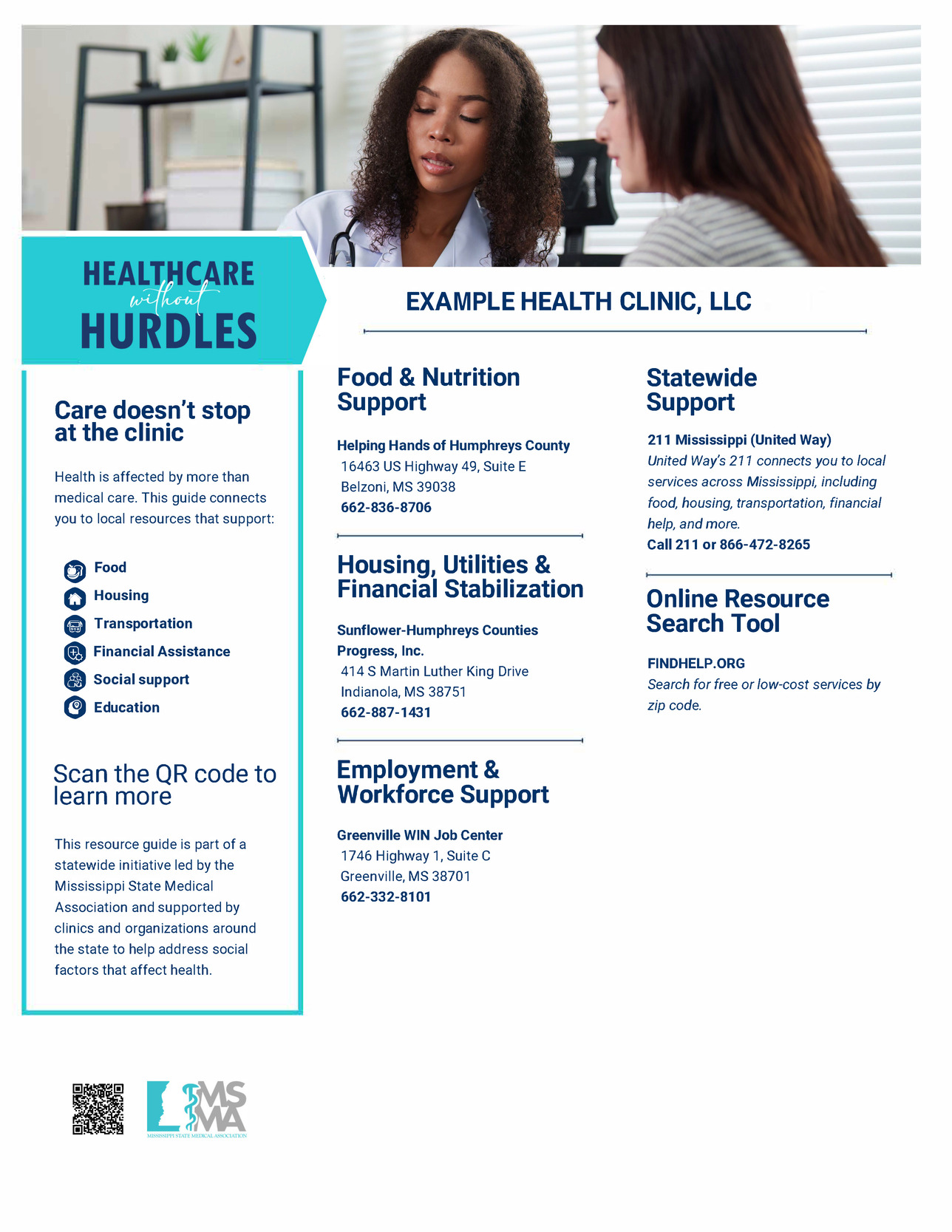
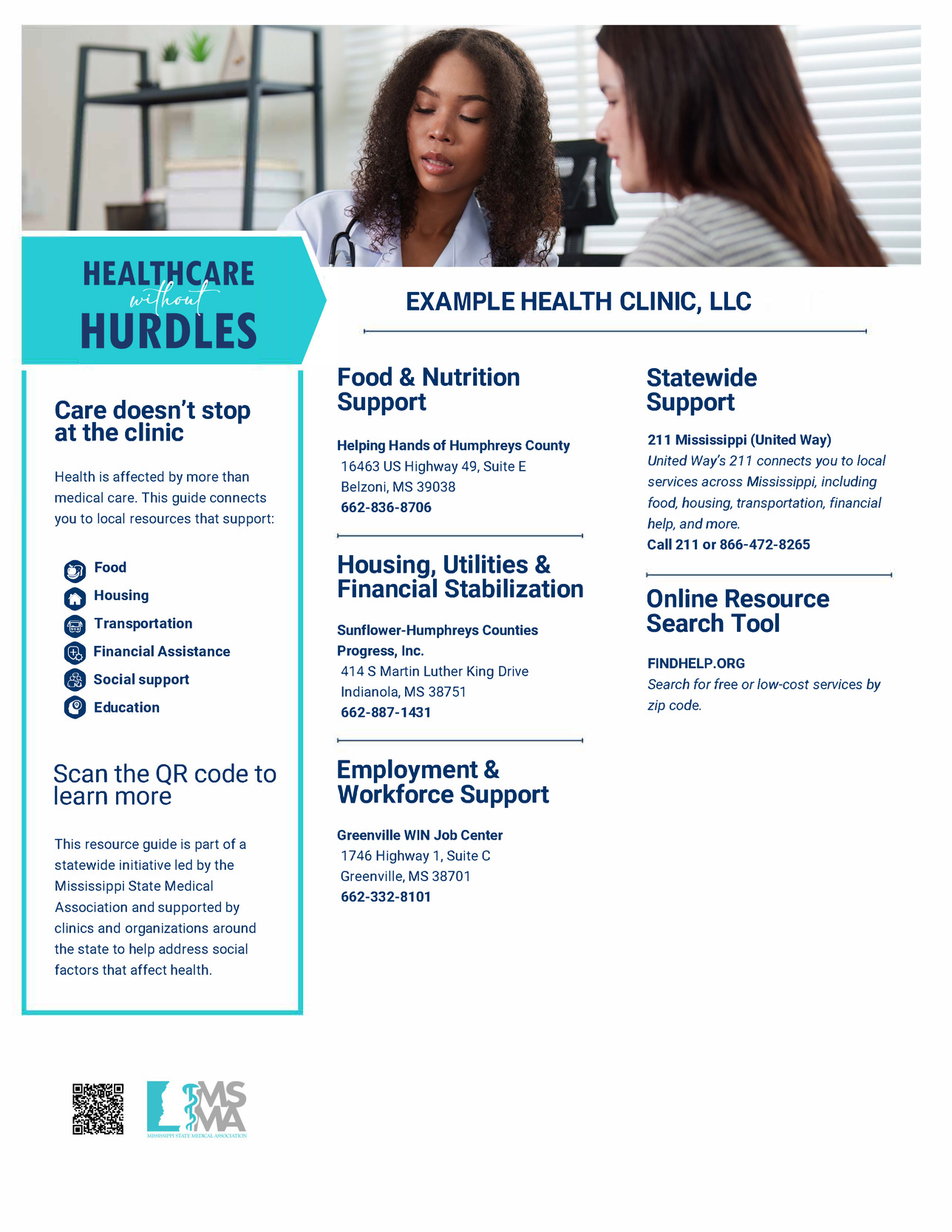
Screening can be difficult to sustain if practices lack clear referral options or confidence that patients can access meaningful support.10,11 Draft region-specific county resource guides were provided to participating pilot clinics for use as patient-facing reference tools and for partner feedback. Supplemental Material 2 includes an example of a clinic-facing adaptation of these resources. These guides were designed to support knowledge sharing and point-of-care referral conversations rather than function as a closed-loop referral or care-navigation system. The guides listed online and local organizations that address identified needs such as food assistance, economic stability, employment support, housing, utilities, transportation, and financial aid services. They also provided contact information for county-specific locations of local food programs, community action agencies, and workforce centers. The guides were written and organized to support easy navigation by both clinic teams and patients.21,22 Because clinic teams may have limited time and familiarity with available community resources, referral tools are more likely to be useful when they can be navigated quickly within existing workflows.9,12,21,22 Structured referral pathways can also help practices respond to identified social barriers without requiring clinicians to assume responsibility for services beyond the scope or capacity of clinical practice.8,12
However, distributing the regional guides as sections within a single consolidated document may have limited their visibility and ease of use among pilot clinics. Based on this implementation learning, the guides will be redistributed as individual regional documents to clinic partners and refined before broader dissemination to MSMA members statewide, planned for December 2026.
While the shared guides reflect the most recent information obtained from partners and available sources, clinic participants were encouraged to cultivate local relationships with the listed organizations as part of ongoing community engagement.8 As funding, staffing, eligibility rules, hours of operation, and service areas change, referral information can quickly become outdated. Direct relationships with community partners can help clinics keep referral information up to date, understand how patients should access services, and communicate practical referral pathways more effectively.9,12
Together, these lessons suggest future efforts should also examine what implementation conditions help practices adopt, adapt, and sustain screening-to-referral workflows. This future includes attention to workflow design, staff preparation, physician communication, patient-facing materials, community partnerships, and the feasibility of shared support models that reduce the burden on individual practices.28
Limitations
Healthcare Without Hurdles was not designed as a controlled research study, and the findings should be interpreted as descriptive program data. The small, unevenly distributed sample is insufficient to establish causal relationships among screening, referral support, patient outcomes, health care utilization, and long-term access to resources. Implementation feedback was limited to physician leadership, limiting our understanding of other clinical staff experiences. The data are also weighted toward clinics that submitted more screening responses and may not fully reflect the experiences of sites with lower screening volume or less consistent workflow integration. Screening data describe patient-reported needs and referral interest but do not indicate whether individuals contacted listed organizations, met eligibility requirements, enrolled in services, or had their identified needs resolved. Establishing patient-level referral tracking and follow-up was beyond the scope of the current initiative. These limitations are consistent with broader evidence on screening and referral interventions, where promising findings exist but definitive conclusions about overall impact remain limited.29 Furthermore, the screening tool does not include a question about insurance coverage, so the analysis omits details on payor mix or insurance category.
Despite these limitations, the initiative provides practical insights into implementation. Its value is not in demonstrating patient-level impact, but in showing how social needs screening unfolded in clinic settings and what types of workflow, communication, staff preparation, and referral-support infrastructure were needed to make the process more actionable.
Conclusion
Healthcare Without Hurdles demonstrates that identifying social needs is only the first step in addressing barriers that affect patient care. Providers may recognize social barriers affecting their patients yet have limited capacity to assess specific needs or identify relevant community organizations. For social needs screening to be meaningful in clinical practice, patient-facing referral tools must be integrated into clear staff communication and referral workflows.8,9,12 Physician associations can serve as practical intermediaries by providing resources that connect patient populations with community organizations that provide social-needs support. Future evaluation should examine the feasibility of more active referral approaches, such as warm handoffs, and assess the staffing and workflow capacity required to sustain them.9,12,29
Mississippi 211 offers one potential statewide referral pathway by connecting callers with health and human service resources based on their needs and geographic area.24 Although similar implementation models require further study, this initiative suggests that associations may help bridge public health and clinical practice by supporting functions that individual practices may lack the capacity to build or sustain independently.
Mississippi’s high burden of chronic disease, rural geography, and physician workforce shortages make it an important setting for evaluating scalable implementation strategies that may be applicable to other underserved states. As health systems increasingly recognize the influence of health-related social needs, physician associations may play a critical role in helping practices move beyond screening toward practical, sustainable referral support that improves patient care.