
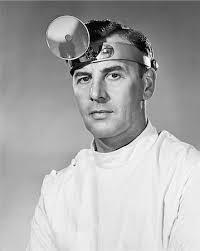
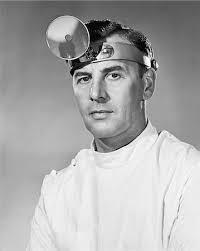
[This issue, I continue a series focused on poems written by C Ron Cannon, MD, a retired Jackson Otolaryngologist and a longtime member of this association, as well as a past contributor to this Journal. My first scientific publication in this Journal was co-written and led by Dr. Cannon, who also served as my teacher and mentor during my medical training.1 He is a gifted physician whose work and teaching influenced many other physicians and improved the lives of countless patients. This poem, “Head Mirror,” reflects on the importance of this classic physician tool in the practice of medicine, especially otolaryngology and family medicine. The head mirror, like the stethoscope, is one of the most identifiable of medical symbols, often seen in art and movie representations of physicians. The physician wears the headband with its mirror on the forehead and swings the mirror down, aligning the central aperture with one eye, usually the right, where the physician can peer through the hole. A bright light source, often a Bull’s Eye Lamp, is placed behind the patient, aimed at the mirror to reflect the light and illuminate the patient. During my Family Medicine training, I remember with affection my mentor, Dr. Hardy B. Woodbridge, Jr. (1923-2002), making an extraordinary effort in the clinic getting the new Family Medicine residents to adopt this historic, effective tool as a basic part of their medical attire. He clearly felt the head mirror was indispensable for the practicing family physician. Although many physicians embrace the headlight or penlight or otoscope over it these days, the head mirror continues to be championed by many, including Dr. Cannon, who asserts: “Head strap and mirror, a simple device/ Its use in practice is paradise!”2
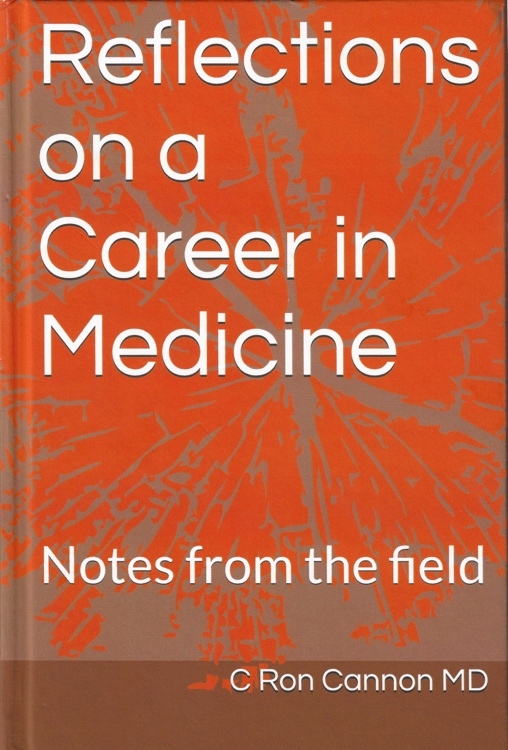
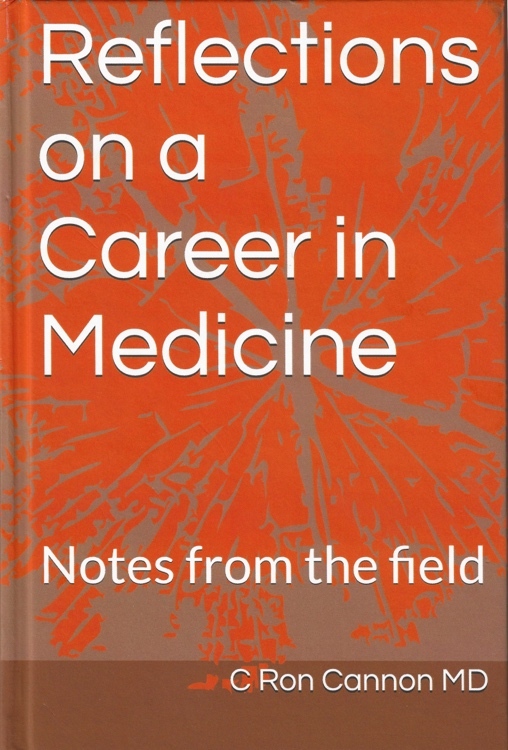
In 2024, Dr. Cannon published a book entitled “Reflections of a Career in Medicine: Notes from the Field,” a brilliant and original collection of thoughts and memories of the practice of medicine over forty years, all expressed in poetic rather than narrative format. This poem is from that collection. He also recently published a second collection of verse entitled “Medical Limericks: A Collection of Aesculapian Witticisms,” which I will sample in future columns.3 In looking over his long career, Cannon remembers, “The majority of the time I did not feel as if I had to go to work, but enjoyed the relationships with other doctors, nurses, and staff members, and especially with my patients. It is meaningful to be able to help folks with their health issues. One of the unique aspects of medicine is that you continue to learn and evolve as a healer.”2 He asserts that he wrote the book as a memoir of his career for his family, fellow physicians, health professionals, and non-medical readers. This unique collection provides ample insights into the practice of medicine and the diverse experiences that health professionals encounter daily.
He adds, “There are over 55 different types of poetry, including, for example, clipping sections from a newspaper or magazine and looking for word patterns. In this broad context, the following collection could be considered to be poetic. I thought this would be a more interesting way to convey my thoughts than simply a matter-of-fact, dry recounting of my experiences in the practice of medicine. In this collection are several different types of poetry. Utilized primarily are couplets with end rhymes, some limericks (well, sort of- but not very bawdy!) about several common patient complaints and other medical specialties. I poke some gentle fun at my friends in other specialties, but also at my own specialty. Anyone who can withstand the rigors of medical school and the following years of specialty training has my utmost respect! Some of the names that I used are indeed fellow docs that I have known, at other times just needed a name that would rhyme. There are also quatrains, cinquains, acrostics, symploce, and a few other forms as well.”2
He revealed, in very kind comments, that this Journal’s regular poetry feature played a key role in his interest in poetic expression: “Oddly enough, my interest in poetry was kindled by the scientific publication of the Mississippi State Medical Association. The Journal features a section on Poetry in Medicine. Many of the poems in this section have been written by Mississippi physicians. These poems were the genesis of efforts to write my own poems.”2
Dr. Cannon has served as President of the American Academy of Otolaryngology / Head and Neck Surgery and for its certifying board. He also served as Chairman of the national ENT Doctors Board of Governors. He and his wife, Beth, live on a lake in Brandon.
Physicians are invited to submit poems for publication in the Journal either by email at drluciuslampton@gmail.com or regular mail to the Journal, attention: Dr. Lampton.]—Ed.
Head Mirror
The cowboy and his ten-gallon hat,
Wearing helmets, footballers-heading into combat
Consider the ENT doctor’s crown,
An adornment of great renown
What follows is a short biopic
Which will make the topic
About the head mirror
So much more clearer
An idea by Levert, a Frenchman,
Who studied the anatomy floorplan
Sometime later Garcia looked at his own larynx
Which as you know is just past the pharynx
Head strap and mirror, a simple device
Its use in practice is paradise!
Simple but elegant is the engineering phrase,
On which various ENT parts to gaze
Its purpose- to provide light,
Better than any flashlight!
More advanced than a candle,
Once mastered- hard to mishandle
The light is reflected off the mirror
Into the mouth, nose, and wherever
Use of the mirror is praiseworthy,
Its use in ENT is newsworthy
The head mirror aids our cause
An instrument with few flaws!
As the head mirror is twirled and whirled
It is the very embodiment of ENT world
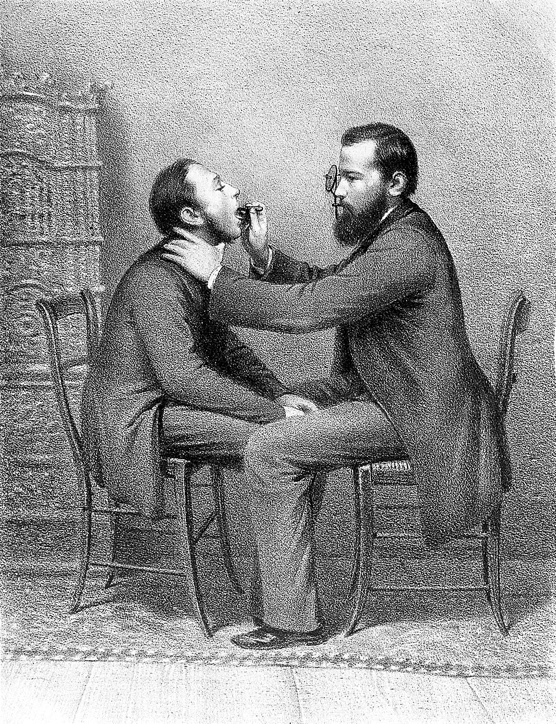
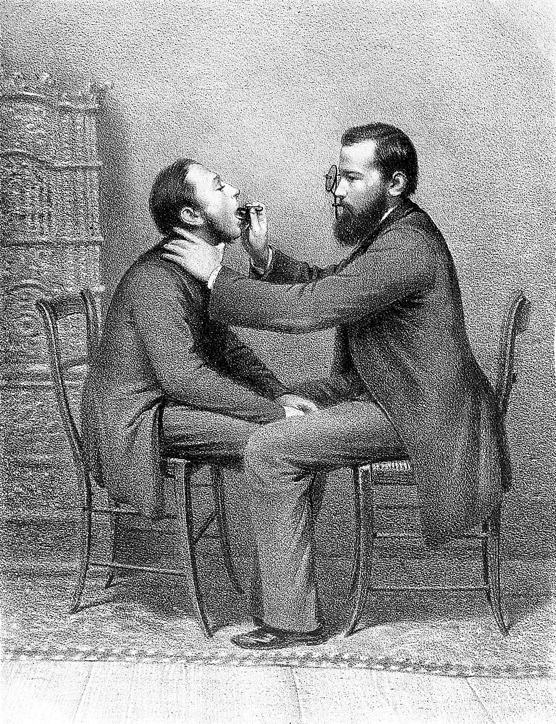
The head mirror is the venerable symbol of the ENT doctor. A light source is placed by the patient’s shoulder and light deflected from the light source off the head mirror and into the patient’s mouth, nose, or whatever site is being examined.4
—C Ron Cannon, MD
Brandon, Mississippi